
[Photo] Stewart Green collection
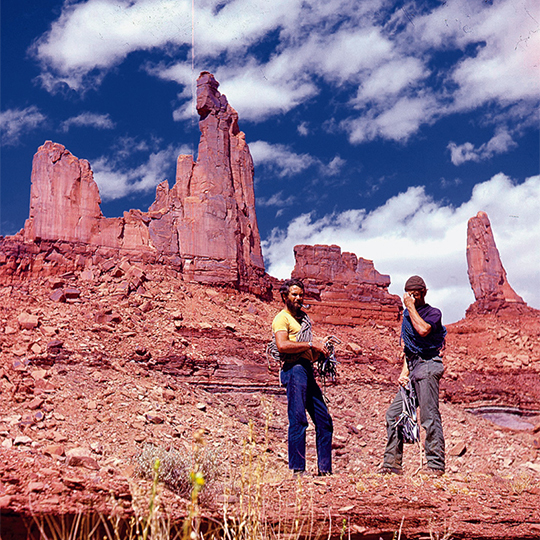
Spring break, March 1973, I sped west to Moab from Colorado Springs to join my climbing buddies Jimmie Dunn and Doug Snively. When I arrived at the River Road, Jimmie said, “You gotta meet Eric. He has this really cool teahouse in town.” We caravanned to the Tea House Tamarisk on Main Street. The place had a twenty-four page menu, over a hundred varieties of herbal teas, and a brass espresso machine with an eagle perched on top. It was really something for a rustic town not far removed from the uranium boom. There, Eric Bjornstad made us steaming cups of black coffee. Then he fired our imaginations with stories of the first ascent of Moses, a spindly tower in Canyonlands National Park–how he and Fred Beckey had seen it during an aerial reconnaissance with Lin Ottinger in 1970, how they’d nailed dead-vertical cracks up the north face, dangling in hand-tied aiders, pounding pitons and fixing ropes. Eric was already a legendary climber. In the 1960s, he’d developed a passion for the kinds of tottering sandstone spires that most climbers shuddered to think about, given the utter remoteness of the desert and the primitive gear of the time. With Fred Beckey and Harvey Carter, he’d amassed a long list of spooky lines.
I often returned to Moab to visit Eric, to go climbing, but also to hike around the back of beyond, find petroglyphs and talk about writing. He wrote a pile of books during those years. In 1985 he moved into Lin Ottinger’s rock shop. “Lin’s wife had just left him,” Eric told me. “He was really happy to see me because I became a housewife. I did all the cooking. I did all the laundry. Did all the dishes. I got free rent. He had a big round table so I put my electric typewriter on it.” Eric’s 1988 Desert Rock was the first climbing guide to the canyon country. He said it took him about three years and eight thousand hours to write: “I went through everything ever published about climbing in the desert.” He wrote four more Desert Rock volumes before concentrating on his autobiography and his poetry about life and love.
In later years, Eric lived in a house trailer at the entrance to Mill Creek Canyon, where he kept a logbook for visitors to scrawl comments. Some of the “notables,” as Eric called them, included Kurt Albert, John Roskelley, and the late German climber Wolfgang Gullich. Eric also had a paperback copy of The Eiger Sanction; he’d worked on the 1975 film as a stand-in for Clint Eastwood in Monument Valley. Both Eastwood and George Kennedy had signed the frontispiece. “Goddammit,” Eric said, holding it up for me in his trailer. “I wish I had it in hardcover. This goddamn paperback is falling apart.”
[Photo] Stewart Green collection
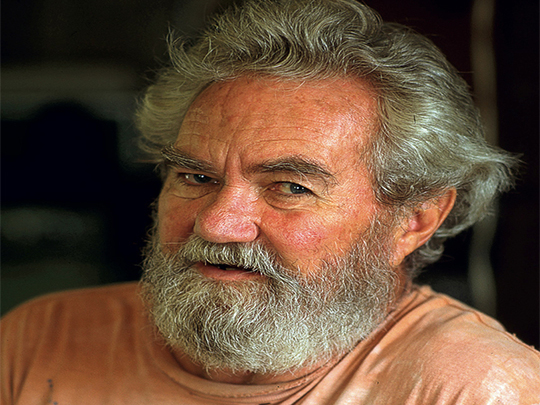
Eric had the distinctive look of a desert rat; the kind that prowls around scrappy sandstone canyons, knows where to find Anasazi rock art, could tell you about seeps that drip clear water and is able to identify all the native plants. He grew a thick beard and swept his receding hair off his forehead. Deep lines creased his sun-weathered face, and crow’s feet radiated from his eyes after decades of squinting in bright desert light. The best way to describe his appearance is to think about a faded photograph of a grizzled man from the Smithsonian Institution’s collection with a caption that might read: “Civil War veteran prospecting in the foothills of the La Sal Mountains, Utah. 1875.”
Eric was an anachronism, a man out of time, one foot in the twenty-first century and one in the nineteenth. But he liked some modern conveniences, such as the stereo system that played his beloved classical music. I’ll miss stopping by Eric’s trailer in winter, the skeletal trees outside the windows rimed with crystal ice, while he worked on his glass ornament etchings. He’d be sitting on his couch amid books, papers and photographs. Two televisions, stacked on top of each other, would be tuned to different programs with the sound muted. An opera, something by Verdi, would be booming. “Come in, come in, Stewart,” Eric would say, “how are you doing, my friend? Do you want a glass of red wine? It’s good for the soul.”
–Stewart M. Green, Colorado Springs, Colorado